
No, not Jimmy Buffet’s hotel. I’ve been there — the resort in Hollywood, Florida, I mean — I went during the summer after freshman year of college with my family and it was a lot of fun, but I regretfully did not have any margaritas there.
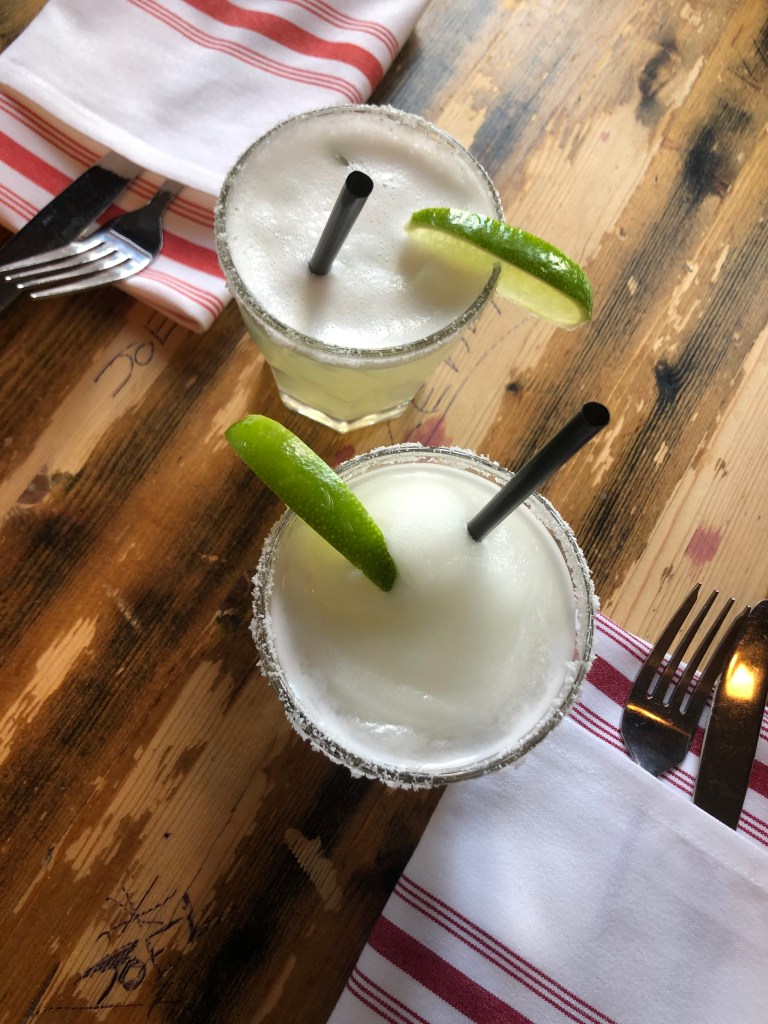
However, I have been on a journey of sorts the past couple of years when it comes to margaritas. I used to absolutely hate them — the smallest sip would have me gagging — and I felt that nauseating way about tequila in general. Let me tell you, a college student who hates tequila is an anomaly, it is almost completely unheard of, and frankly I have received quite a few judgement-filled glances when I have turned down tequila shots or sharing pitchers of margaritas in the past.
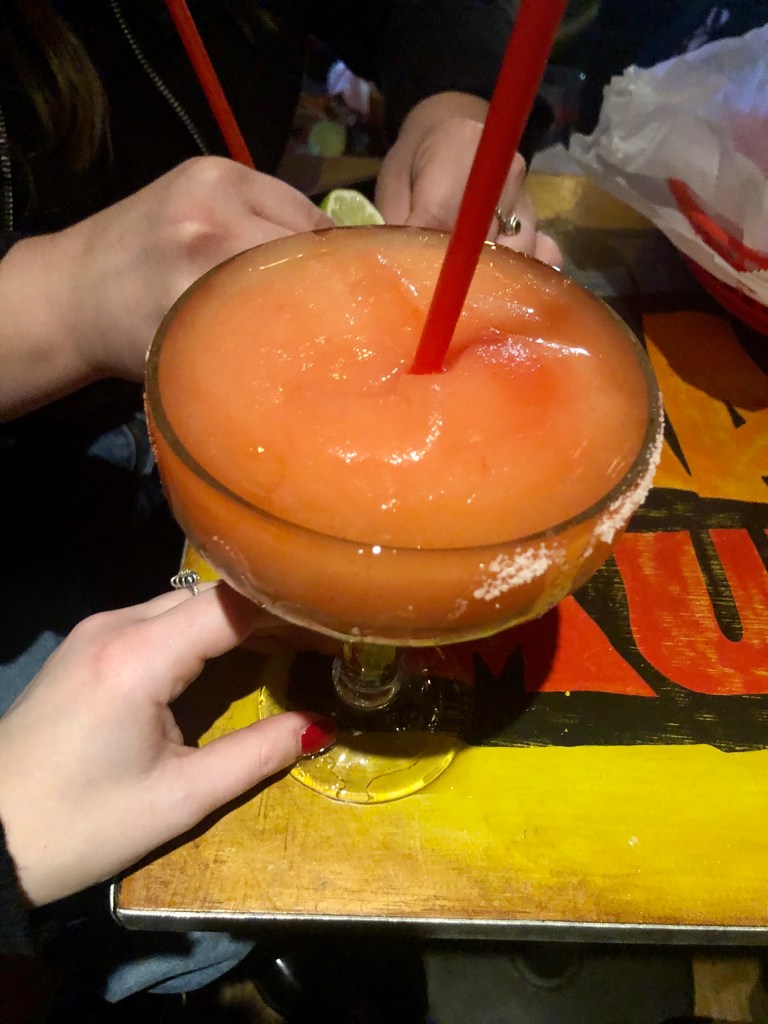
But, as I said, I have been on a journey. People change! I am not exactly sure when I started to warm up to tequila (but only warm up, I’d never call myself a fan), but one day I all of a sudden found myself ordering margaritas at Mexican restaurants and thoroughly enjoying them. While I prefer a frozen strawberry margarita, because obviously they are much sweeter and much easier to take down, I no longer feel my stomach turn even with a classic on the rocks.
I don’t know where this change came from, but I am definitely happy about it.
Similar to my shift in drink preferences, the margarita itself does not really know where it came from. There are many conflicting stories surrounding the history of the margarita with many different people claiming that it was their brainchild. I mean, I get it — who wouldn’t want to take credit for one of the most enjoyed, tried-and-true cocktails the world has to offer? Taking all of the self-proclaimed creators into consideration, let’s assume that at least one of them has to be the real inventor.
The most integral part to understanding the margarita, however, is understanding tequila. Tequila, before it grew up to become the liquor that college students worship as a deity today, was first fermented by the Aztecs sometime before A.D. and was actually worshiped as a deity. Back then, this fermented agave was called “pulque” and legitimately led to the worship of a god named Patecatl — you guessed it, the god of pulque.
Around the 1400s, when Spain conquered Mexico, the Spanish did what the Spanish did back then — stole the Aztec’s indigenous ideas and made them their own. Spain began to distill agave themselves, in a different fermentation-like process than the way pulque was made. Thus, modern mezcal was born.
Moving forward, every tequila drinker’s best friend Jose Cuervo and the Cuervo family began making tequila and selling it to the public in 1758. As I will discuss later, Cuervo tequila had a large hand in the popularization and commercialization of the margarita. God bless Jose, am I right?
But what makes tequila so uniquely Mexican? Sure, mezcal and sotol are originally Mexican-made and also are derived from distilling agave — but why does tequila hold such a special place in Mexico’s (and America’s and, well, everywhere’s) heart? In 1973, the Tequila Regulatory Council was founded and tequila was officially declared Mexico’s “intellectual property.” This means that all tequila has to be distilled in Mexico and it is illegal for other countries to produce their own versions.
So now, knowing more about tequila itself — the heart and soul of the margarita — let’s peruse the wide range of possible origin stories associated with that coveted drink.
What’s Your Name and Where Are You From?: The Many Histories of the Margarita
Like with all stories that take on multiple variations, some claims about who truly created the margarita are more popular than others. The two most well-known names surrounding the classic cocktail are Carlos Herrera and Margarita Sames. No one really knows who is to single handedly thank for the margarita, but one thing that has been agreed upon is when the margarita first came into being: sometime during the 1930s… or maybe it was the 1940s.
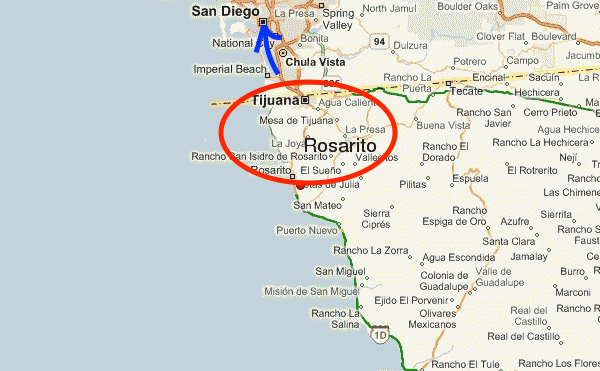
Carlos “Danny” Herrera was a restaurant owner in the Tijuana-Rosarita area of Mexico. According to the story, around 1938, a showgirl named Marjorie King used to frequent Herrera’s restaurant, Rancho la Gloria. She was allergic to all hard alcohol except tequila and, wanting to impress her with something enjoyable and refreshing, he combined a tequila shot with some lime and triple sec. Behold — the margarita was born. One of Herrera’s friends owned a bar in San Diego called La Plaza and took Herrera’s creation back to America with him, popularizing the cocktail in Southern California in the 1940s and effectively igniting the margarita’s successful career in the United States.
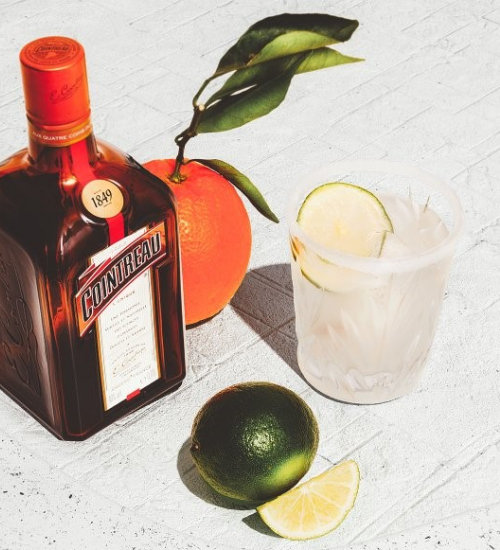
If it wasn’t Herrera who created the drink and the owner of La Plaza who took it back to America, maybe it was Margarita Sames. Sames was a socialite from Dallas, Texas, who used her money to throw large parties and impress her guests. Think Daisy Buchanan but the late 1940s with a Tex Mex vibe. During one of her parties at her vacation home in Acapulco, Sames picked up a glass shaped like a sombrero, covered the rim in salt, filled it with her two favorite liquors (tequila and Cointreau), and served it straight up to her guests with a lime. Supposedly one of her guests was from Spain and decided to name the new creation “margarita.”

Did the creator of the cocktail truly just name it after herself? It is for sure a possibility. Sames’ story must be taken with a grain of salt — no pun intended. This version of events was detailed by the Cointreau family’s ambassador and, obviously, it is in their best interest to tell a tale that includes a passionate love for Cointreau liqueur. Sames also claims to have created the margarita in 1948, three years after Jose Cuervo first advertised the margarita as a tequila cocktail. Well, that doesn’t quite add up…

Who knew the history of the margarita would be as big of a mystery as the Zodiac killer’s identity — crazy stuff!
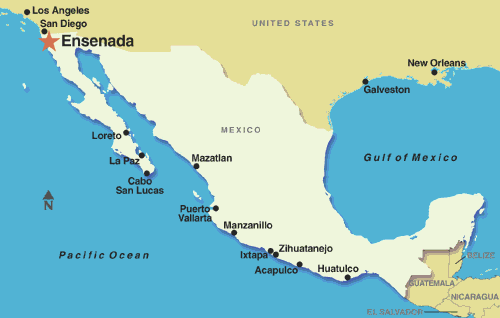
Other possible inventors include Don Carlos in 1941. Don Carlos was a bartender at Hussong’s Cantina in Ensenada, Mexico, and was experimenting with new drink concoctions. He tested out what came to be known as the margarita on a patron named Margarita Henkel, and subsequently named it after her.
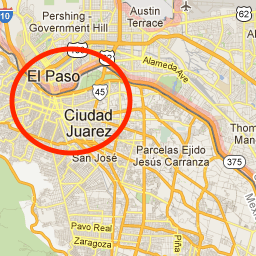
Francisco “Pancho” Morales was a bartender in Mexico, on the El Paso-Juarez border. In 1942, he worked at a bar called Tommy’s Place and a customer came in requesting a magnolia. Unsure of how to make one but too proud to admit defeat, Morales threw some different liquors and lime juice together and served it to the customer. Whether the customer called Morales out for serving him something completely wrong, I’m not sure, but he supposedly loved it and the drink was called a margarita. The LA Times has backed Morales’ story as “the strongest claim” to who invented the margarita but his is still much less well-known than Herrera’s and Sames’. Margaritas came to America with Morales after he moved from Mexico to work as a milkman. From slingin’ margs to slingin’ milk!
In my opinion, whatever story one chooses to believe doesn’t really matter. Would it be nice to know who truly invented the margarita and how it migrated from Mexico to the United States? Yes, but no one is going to stop drinking margaritas just because the history is a bit fuzzy! The margarita was created, it was brought to America, Mariano Martinez decided to freeze it in the 1970s, somewhere along the line someone decided to add strawberry flavoring, and now here I am ready and willing to order a pitcher.
Just as all of America has been willing since its creation. It is a sad yet slightly morbidly funny paradox to think about how unwilling America was to accept Mexican people but how excited we as a country were to consume Mexico’s cuisine when it became popularized in the mid- to later-1900s. But, before America was truly open to Mexican food, it was willing to try its cocktails — if we can get drunk, we can be okay with other cultures, right? In his book Taco USA, Gustavo Arellano notes,
The frozen margarita machine came just as the sit-down Mexican restaurant scene was taking off — really, the surge Chi-Chi’s, El Torito, and others experienced during the 1970s wouldn’t be possible without alcohol to lure in people to casually try the Tex-Mex-Cal-Mex platters the restaurants served almost as sides. The cocktail fueled happy hours, disco nights, the go-go 1970s, and remains how America best loves its Mexican booze.
(Arellano 240)
Arellano’s discussion of the frozen margarita machine as an ice-breaker for Mexican food, similar to the way a margarita itself might be an ice breaker on a first date, reveals how problematic America’s relationship to anything-and-everything Mexican has always been — and, sadly, continues to be. However, it is thanks to the frozen margarita that acceptance and embracement of Mexican culture in America ever truly began. Although “acceptance” might seem like a strong word considering today’s political climate, and there are undoubtedly many issues with the idea that alcohol was the only way America was willing to peak into Mexican culture and cuisine, it is truly groundbreaking that such a simple yet beloved beverage could be the catalyst for the cultural integration that we are still working towards in this country today. As someone with no personal ties to Mexican culture or identity, but someone who dearly loves Mexican food and especially frozen margaritas and greatly admires Mexico’s complex and fascinating cultural history, I believe it is incredibly important that people in the 1970s put aside their xenophobic and racist tendencies — if only for a moment — to try a delicious margarita, and subsequently a taco or burrito or quesadilla, and finally come to the realization that this is a culture and cuisine that deserves to be celebrated.
One Tequila, Two Tequila, Three Tequila, Floor!: How to Properly Make a Margarita
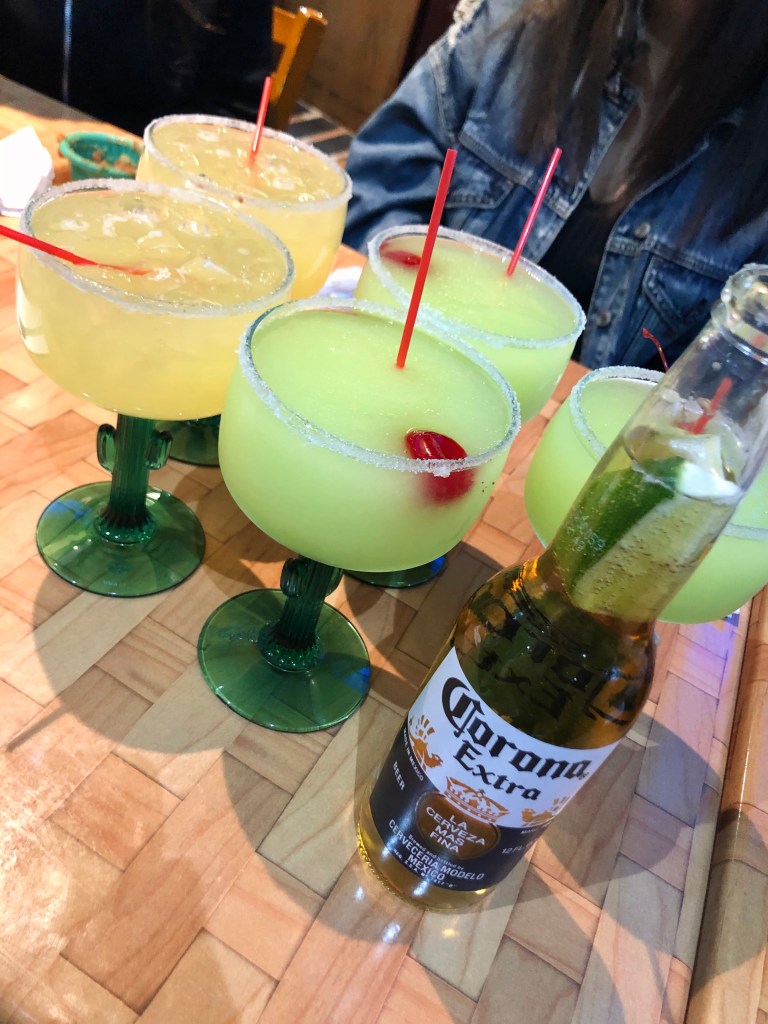
Okay, I’ll make the disclaimer now that there truly is not a correct or incorrect way to prepare and enjoy a margarita. As I have said many times, I like mine frozen and fruity and sweeter than tart — on the other hand, my friend Sarah will only drink classic lime on the rocks. When we make them in my house, they are made up of a store-bought, sweetened lime juice/simple syrup type of amalgamation and no-name silver tequila and triple sec out of plastic bottles (we’re college students on a budget, okay!). We simply eyeball the measurements, mix it all up in a pitcher (which once acted as a Brita filter), and we serve them proudly in Solo cups. Can you say stereotypical college kids? No matter what, margaritas are personal and they are all beautiful in their own way!
The following recipe for the self-proclaimed best margarita ever is from Bon Appetit. I am a huge and I mean HUGE Bon Appetit fan, and I trust them and the recipe’s creator Chris Morocco indefinitely, so I believe it when they say this is BA’s Best!
It calls for:
2 oz. tequila blanco (probably not out of a plastic handle)
¾ oz. fresh lime juice
¾ oz. simple syrup
Lime wedges for garnishing
Kosher salt to rim old-fashioned or rocks glasses
Surprisingly, this recipe does not call for triple sec or Cointreau. Usually, margaritas include equal parts tequila and triple sec, so 2 oz. would complement this recipe perfectly. But, as I mentioned, I tend to take what Chris Morocco says as gospel so I trust that it does not really need it. Add it if you want to! Don’t if you don’t! As long as we can all enjoy a margarita from time to time, does it really matter what exactly it consists of?
Just maybe don’t add too much tequila… that’s never done anybody any good, don’t let it fool you!
Many Beauty Queens In This Locality… When We’re Talking Margs
Unlike what the band Queen suggests in their song “Fat Bottomed Girls,” margaritas across different localities are in fact all beautiful (no, they were not talking about margaritas, but music is art and art is subject to interpretation so it fits!). But what kinds of local varieties does the margarita fall subject to? Similar to the way New Yorkers and Chicagoians fight to the death about whose local pizza is better (it is obviously New York, but we are not here to discuss pizza), different Mexican cultural groups must also hold their personal version of a margarita near and dear — right?
After spending multiple hours researching margaritas — who knew that was possible? — there does not seem to be too much variance of the drink from Mexico to America and across the country. A “classic” (lime on the rocks) is obviously much more traditionally Mexican than its frozen, sweet variants that we see in trendy Mexican restaurants in the United States today. However, from posh and “Mexican-inspired” restaurants to the most authentic mom-and-pops, people have always and probably will always order and enjoy margaritas. No margarita no matter where it is being made strays too far from its roots: tequila, triple sec or Cointreau, lime juice, simple syrup, salt on the rim. And no one — except silly, naive me a few years ago — is mad at that.

 We Stan Tacos